
The Complete Guide to Laser Skin Treatments at Seamless Skin M.D.: What Each Device Actually Does
Laser treatments have become one of the most effective, versatile ways to rejuvenate skin without surgery or long downtime. But patients often find themselves overwhelmed by the number of devices, settings, wavelengths, and treatment strategies available. You might know lasers can help with discoloration, texture issues, scars, or signs of aging, but you may not know which laser does what, whether certain lasers are safe for your skin type, or what kind of results you should realistically expect.
This guide breaks everything down in a straightforward, patient-friendly way. Instead of listing machines and medical jargon, we’ll focus on what each type of laser actually does, who it’s best for, and the questions people ask most when considering laser treatments at Seamless Skin M.D.
What laser treatments are used for—and why they work
Laser devices target skin concerns by delivering controlled energy to the skin. The depth, intensity, and wavelength determine what they treat and how dramatic the results can be.
Most treatments fall into one of three categories:
1. Treating pigment
Hyperpigmentation, sunspots, melasma, and uneven tone respond to lasers that break apart excess pigment so the body can naturally clear it.
2. Treating texture
Rough patches, acne scars, enlarged pores, and fine lines are improved by lasers that stimulate collagen and remodel the skin’s surface.
3. Treating redness
Lasers can target blood vessels beneath the skin to reduce redness, flushing, and visible veins.
Many devices overlap in what they can treat, which is why the skill and experience of your provider matters. At Seamless Skin M.D., each session is customized so you get the correction you need without unnecessary downtime.
Which laser is right for my skin concerns?
Choosing the right treatment starts with understanding the basics of laser categories. Here’s a breakdown of the most common types used in modern medical aesthetics.
Ablative vs. non-ablative lasers: What’s the difference?
This is one of the biggest questions patients ask.
Ablative lasers
These lasers remove the outer layer of skin to reveal smoother, healthier skin underneath. They deliver dramatic results, especially for deeper wrinkles and scars, but also come with more downtime.
They’re best for:
- Deep texture issues
- Moderate to severe wrinkles
- Acne scarring
Non-ablative lasers
These lasers heat the deeper layers of skin without damaging the surface. They stimulate collagen production and improve tone, texture, and firmness gradually.
They’re best for:
- Mild to moderate fine lines
- Sun damage
- Enlarged pores
- Pigment and redness
- Skin tightening
Non-ablative lasers are popular because they offer noticeable results with minimal downtime.
Fractional lasers vs. full-field lasers
Another common question calls for a quick explanation:
Fractional lasers
These devices create micro-injuries in a “pixelated” pattern, leaving untreated skin between the targeted areas. This supports faster healing and makes the treatment more customizable.
Full-field lasers
These treat the entire surface of the skin and are usually reserved for more aggressive resurfacing.
Most modern treatments use fractional technology because it provides a strong balance between results and recovery time.
How laser treatments improve specific skin concerns
Let’s break down what patients often want corrected and how lasers address each issue.
1. Hyperpigmentation and sun damage
Sun exposure is the biggest cause of dark spots and uneven skin tone. Lasers can safely break up pigment so the body can flush it out over time.
These treatments can target:
- Sunspots
- Age spots
- Freckles
- Uneven tone
- Some types of melasma
Non-ablative pigment-targeting lasers are effective with little to no downtime. You’ll usually see dark spots darken temporarily before they flake off.
FAQ: Is laser treatment safe for melasma?
Melasma is complex and can worsen with heat. Certain lasers are appropriate only when used conservatively. Some patients respond better to chemical peels or topical treatments. At Seamless Skin M.D., your provider will determine whether a laser or an alternative treatment will give the safest outcome.
2. Redness, flushing, and visible veins
A vascular-focused laser can help reduce redness and improve skin clarity by targeting blood vessels beneath the surface. The light energy causes those vessels to collapse and be reabsorbed by the body.
These are ideal for:
- Rosacea
- Facial flushing
- Broken capillaries
- Red acne scars
- Generalized redness
Patients usually notice improvements after just one session, with minimal downtime.
3. Fine lines, creases, and early aging
Laser resurfacing is one of the most powerful ways to improve early signs of aging. Non-ablative fractional lasers stimulate collagen, which naturally tightens and smooths the skin over time.
You’ll see improvements in:
- Fine lines around the eyes
- Lines across the cheeks
- Mild sagging
- Dullness
The key advantage is that results continue to improve for months as collagen remodels beneath the surface.
4. Acne scars and texture issues
Texture problems respond well to fractional resurfacing because the laser creates micro-channels that trigger healing and new collagen formation.
This can help with:
- Atrophic acne scars (pitted scars)
- Rough texture
- Enlarged pores
- Post-inflammatory marks
A series of sessions usually provides the best results.
What to expect before your first laser session
If you’re new to lasers, you might not know what the prep looks like. Thankfully, it’s simple.
Your provider will:
- Review your medical history
- Evaluate your skin type and concerns
- Map out the areas to treat
- Customize the energy level and settings based on your goals
- Create a treatment plan, often recommending multiple sessions for best results
How to prepare:
- Avoid tanning and sun exposure
- Pause retinoids a few days prior
- Arrive with clean, makeup-free skin
If needed, numbing cream can be applied for comfort.
What happens during the treatment?
A session usually lasts between 15 and 45 minutes, depending on the treatment area and laser type.
Here’s the typical flow:
- Skin is cleansed
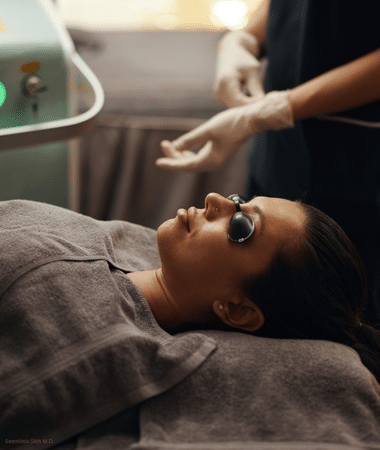
- Protective eyewear is given
- Numbing is applied if needed
- The laser handpiece is moved across the skin in precise passes
- You may feel warm zaps or tingling
- Skin may appear pink or warm afterward
Most patients find the experience very manageable, especially with non-ablative devices.
How much downtime should you expect?
Downtime varies widely depending on the intensity of the treatment.
Minimal downtime (non-ablative)
- Redness for a few hours
- Possible mild swelling
- Makeup can be worn the next day
Moderate downtime (fractional resurfacing)
- Redness lasting a few days
- Skin may feel rough or sandpaper-like
- Light peeling may occur
More intense resurfacing (ablative)
- Longer recovery
- Peeling and crusting
- Strict aftercare requirements
Most patients at Seamless Skin M.D. choose treatments that offer strong results with predictable, manageable downtime.
How long until you see results?
Results depend on the type of laser.
Pigment-targeting lasers
Dark spots look darker at first, then flake off within 7–10 days.
Vascular lasers
Redness improves gradually over 2–4 weeks.
Fractional resurfacing
Texture and tone improvements appear around 3–6 weeks, with collagen continuing to build for 3–6 months.
Ablative resurfacing
Patients often see dramatic changes within a few weeks, with continued refinement over several months.
Many treatments deliver progressive improvement, which is why a series of sessions is often recommended.
Are laser treatments safe for all skin tones?
This is one of the most important questions patients ask.
Some lasers pose a risk of hyperpigmentation for deeper skin tones, but modern technology has widened the options significantly. Certain wavelengths and settings are safe and effective for a wide range of skin types when used correctly.
At Seamless Skin M.D., your provider will evaluate:
- Fitzpatrick skin type
- History of pigment conditions
- Sensitivity
- Current medications
- Lifestyle factors
Laser safety depends on choosing the right device and making sure it’s used by someone trained in treating diverse skin types.
Do results last?
Yes, but aging and sun exposure continue to influence the skin. Most patients maintain results with:
- Annual or semiannual maintenance treatments
- A personalized skincare routine
- Sun protection
- Occasional combination treatments like peels or microneedling
Combining modalities often enhances results, especially for texture, discoloration, or early aging.
Frequently asked questions
“Are lasers better than peels or microneedling?”
Not better—just different. Peels are great for exfoliation and brightening. Microneedling stimulates collagen but doesn’t target pigment. Lasers can treat pigment, redness, and texture with more precision.
“Can I combine laser treatments with injectables?”
Absolutely. Many patients pair lasers with Botox, Dysport, or fillers for comprehensive rejuvenation.
“Will it hurt?”
Most non-ablative lasers feel like warm snaps or prickles. Numbing is available when needed.
“How many sessions will I need?”
Depends on your goals. Pigment may clear in one session. Texture and collagen improvements often need a series of treatments.
Why choose Seamless Skin M.D. for laser treatments?
The difference is in customization.
Your provider doesn’t rely on one device or a one-size-fits-all protocol. Instead, each treatment plan is built around:
- Your skin type
- Your goals
- The severity of your concerns
- Your tolerance for downtime
This ensures you get the best possible outcome safely and consistently.
Ready to explore laser treatments
Whether you want to lighten dark spots, smooth acne scars, soften fine lines, or simply refresh dull skin, laser treatments can deliver powerful, long-lasting improvements. Schedule a consultation at Seamless Skin M.D. to find out which option fits your needs and what kind of results you can expect.
Your skin has the ability to renew itself. Laser treatments simply help it do that more effectively, with precision and control.